
Agentforce Contact Center: Salesforce finally close the Loop on CX
For years, enterprise contact centers have been held together by integrations rather than architecture — a CRM here, a telephony platform there, an AI layer bolted on top. Salesforce just made a decisive move to end that story. And the implications for how organizations deliver customer experience are significant.
3/17/20263 min read
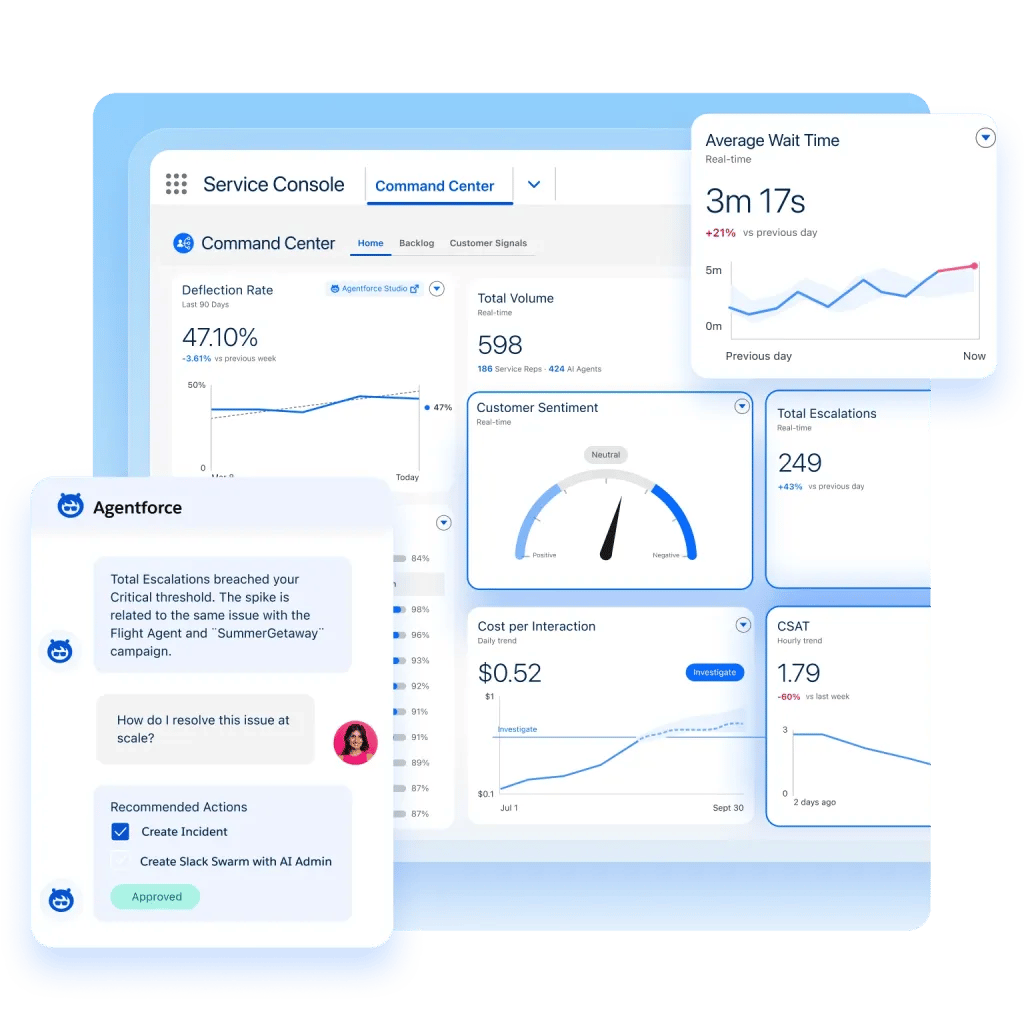
For years, enterprise contact centers have been held together by integrations rather than architecture — a CRM here, a telephony platform there, an AI layer bolted on top. Salesforce just made a decisive move to end that story. And the implications for how organizations deliver customer experience are significant.
What Salesforce actually launched
On March 10, 2026, at Enterprise Connect, Salesforce introduced Agentforce Contact Center — described as the only solution that natively unifies voice, digital channels, CRM data, and AI agents in a single system. The key word here is native. This is not another integration layer or an appended module.
For over a decade, Salesforce served as the CRM backbone while outsourcing voice to partners like Genesys, NICE, and Five9. Agentforce Contact Center changes that equation fundamentally, bringing telephony infrastructure in-house, built from the ground up on Salesforce's Hyperforce architecture.
"By treating voice, AI, and CRM as a single service nervous system, we give human and AI teams the shared context they need to turn every interaction into a resolution." — Kishan Chetan, EVP, Agentforce Service, Salesforce
The product is now generally available as an add-on to all Agentforce Service (formerly Service Cloud) customers in the United States and Canada. Global availability is expected to expand later in 2026.
Why this matters — and what it changes
The contact center has long been the most fragmented part of the enterprise stack. Organizations pay what analysts now call an "integration tax" — not just in license fees, but in latency, lost context, and the inevitable friction that leaves customers repeating themselves on every transfer.
Agentforce Contact Center is Salesforce's answer: consolidate the entire service operation — CRM data, voice, digital channels, and AI agents — into a single execution layer. Early adopters are already reporting meaningful results.
The architecture also changes how voice data is treated. Previously, phone calls largely disappeared after ending — a recording sitting separately from the CRM, rarely used systematically. Agentforce Contact Center processes voice natively within Salesforce, turning unstructured audio into structured customer intelligence in real time. Supervisors gain sentiment visibility; AI agents get a richer feedback loop to improve accuracy.
The market shift: from AI in the contact center to AI as the contact center
This launch is not an incremental product update. It represents Salesforce staking a clear position in a market it previously chose to partner around — and that has cascading consequences for established CCaaS vendors like Genesys, NICE, and Five9.
Salesforce built a dedicated team over the past 15 months, recruiting telephony and CCaaS talent from all five Gartner Magic Quadrant leaders. The ambition is explicit: position Agentforce Contact Center as both the CRM brain and the CX execution engine — a convergence that Kishan Chetan described as inevitable given the demands of agentic AI.
The implication for enterprises is real: organizations that are already on Salesforce now have a credible path to consolidate their contact center stack without the construction project of stitching together multiple vendors. Those with existing CCaaS contracts will need to weigh switching costs carefully — but the architectural case for consolidation is becoming harder to ignore.
What this means for your implementation
The promise of a unified platform is real. So is the complexity of getting there. Agentforce Contact Center is a significant architectural shift, and organizations evaluating it face genuinely hard questions: How does it integrate with existing telephony contracts? What's the right migration sequence? How should AI containment thresholds be configured for your industry's regulatory environment?
These are not questions Salesforce's own documentation will fully answer — they require deep CX expertise combined with hands-on Salesforce implementation experience. The system integrators already working with Agentforce Contact Center in pilot environments understand this. The learning curve is real, but so is the opportunity for organizations that move decisively with the right partner.
---------
Latitude CX brings a rare combination: deep Salesforce platform expertise and domain specialization in contact center transformation. We work at the intersection where CRM strategy, AI deployment, and operational change management converge — precisely the space where Agentforce Contact Center implementations succeed or stall.
engage@latitude.cx
© 2025. All rights reserved.
Latitude CX Inc.




GLOBAL HQ
8000 Avalon Blvd
Alpharetta - GA, USA
LATAM
Av. Dr. Cardoso de Melo, 1460 São Paulo, Brazil